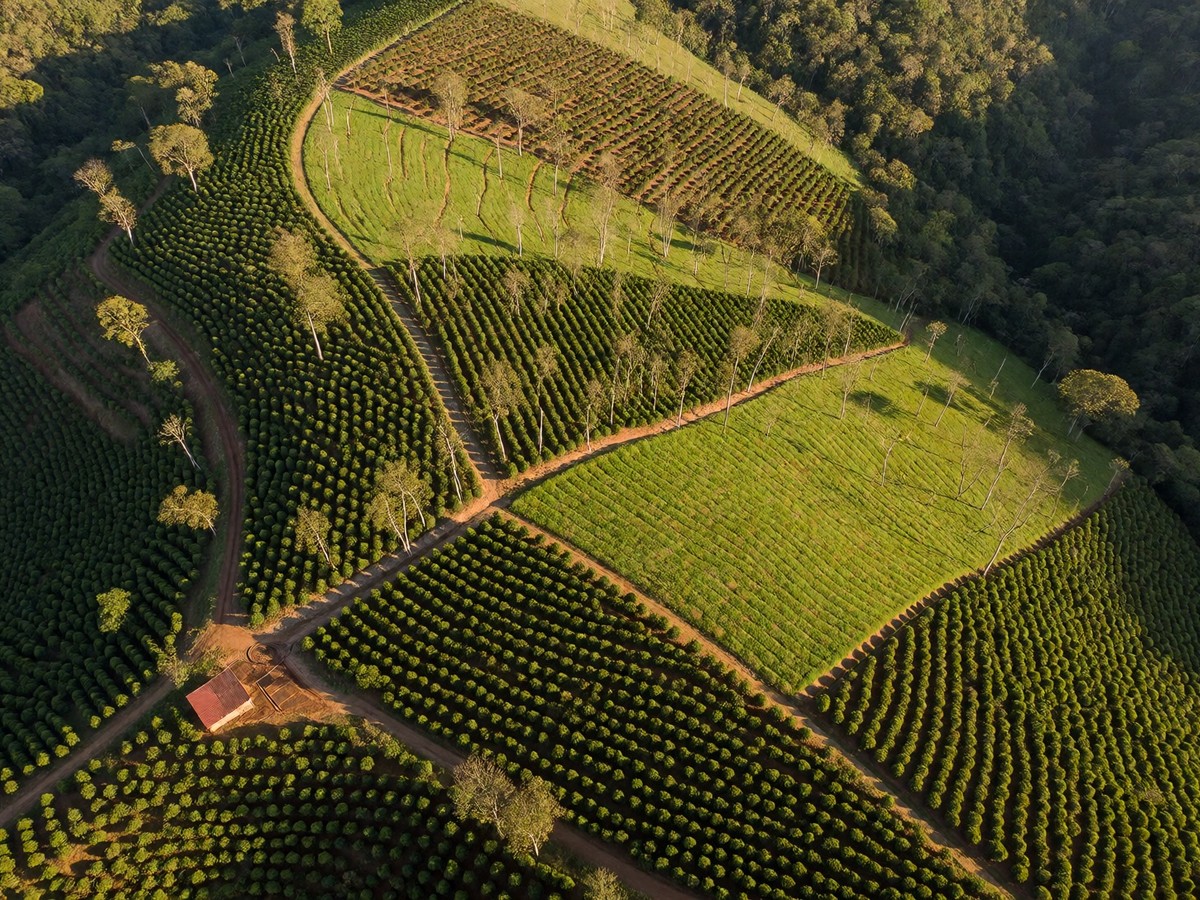
Seven arabica farms in Minas Gerais, Brazil, prove that regenerative agriculture can be economically competitive while maintaining strong productivity. The Global Coffee Platform led this field test of economic, agronomic, and environmental performance across these specific sites. Although the small, non-representative sample cannot generalize to the broader sector, the results offer concrete data points for producers considering a transition away from conventional methods. I find the focus on real-farm observations particularly valuable compared to the largely modeled research that has dominated the conversation until now.
Costs and Productivity
Effective operating costs on the seven farms ranged from R$488.41 to R$745.61 per 60-kilogram bag, all below the March 2025 Minas Gerais benchmark of R$768.80 published by CONAB. Average productivity among the regenerative plots reached 45 bags per hectare, significantly exceeding the 2025 national average of 30.4 bags per hectare for both arabica and robusta coffee. The study explicitly states it does not establish that regenerative practices caused the higher yields or lower costs, a necessary caveat for any investor evaluating the model. Pedro Ronca, GCP Brazil Program Director, noted that different combinations of regenerative practices deliver competitive production systems provided they are adapted to local conditions, implemented consistently, and supported by technical guidance. This consistency requirement is critical, as the four mechanized and three manual labor farms in South of Minas and Cerrado Mineiro showed varied approaches to soil cover and organic inputs.
Soil Depth and Carbon Metrics
Soils generally showed favorable conditions in the upper 20 centimeters, but testing between 20 and 80 centimeters revealed problems involving calcium and magnesium balance, aluminum saturation, and other conditions restricting root growth. Similar limitations appeared in both regenerative and reference plots, indicating that surface-level improvements do not guarantee deep soil health. The authors identified improving soil fertility at depth as one of the strongest opportunities for increasing drought resilience and production stability. For the coffee production systems modeled at all seven farms, estimated carbon removals exceeded modeled emissions according to analyses conducted by Solidaridad using the Cool Farm Tool. Synthetic nitrogen fertilizers accounted for 46% of modeled greenhouse-gas emissions, while management of agricultural residues such as coffee husks, leaves, and pruning material accounted for another 37%. Annette Pensel, GCP Executive Director, stated that generating this evidence pre-competitively allows the sector to invest with confidence, turning intent into targeted investment to support producers through the transition.
Topics